
Race
Spartathlon: The race I should have left unfinished
246 km, 34 hours fighting the pain at Spartathlon, the endless snake made out of asphalt.
17 min read
After almost 1,500 kilometers of training and many hours of stress from combining that training with a full-time job and an autoimmune disease, I took the plane to Athens full of doubts. I still felt the stress from the pressure at work, and its toll on the symptoms of my disease. I was also thinking that I could not remember starting any other race in a similar state. Next to me, my wife reminded me of a few: 3 h 2 min at the Chicago Marathon, my personal best at the time, and 3rd place at Rincón de la Vieja 50K, my first ultramarathon. In both I was fighting similar situations. Although next to the 246 km I was about to face, those now seem like incomparable efforts, at the time they seemed impossible to me.
Something I have learned in these 9 years of running is that my body and my mind have a “race mode”. Usually, when a race starts, I feel stronger and healthier than what I was feeling before. Could be adrenaline, or maybe it is also self-gratitude, for finally having a few hours that are really just me, alone in my head, in the present moment, listening fully to my body.
km 0 · Sat 07:00
“First of all, while they were still in the city, the generals sent off to Sparta a herald, namely Pheidippides an Athenian and for the rest a runner of long day-courses and one who practised this as his profession.”
km 0 · Sat 07:00
On Saturday at 7 a.m., Spartathlon starts at the foot of the Acropolis, the most iconic place in Athens. A few minutes before seven, 400 runners wait anxiously for the start, most of them with the other runners from their country and their crews. I was the only Costa Rican. I waited under a small umbrella with my wife and my mom, who would crew for me during the race. At 7 sharp we started running, still in a light rain that would keep us wet for the rest of the day. At that moment I didn’t know that Spartathlon would be like a venomous snake made out of asphalt that I would have to fight for more than 34 hours. That fight would leave its marks.
km 0 → 43 · Sat 07:00 → Sat 11:05
During the first few kilometers, all I wanted was to get out of Athens. In my innocence of trail runner, I thought that once we got to the countryside everything would be prettier, calmer, easier. Instead, after leaving the city we started running on highways, with trucks passing right next to us, around refineries and the occasional ruin or ocean view, which gave a little break from the monotony. From early on I already felt overwhelmed and bored by the route. I knew already at that point that I would never want to run this route again.
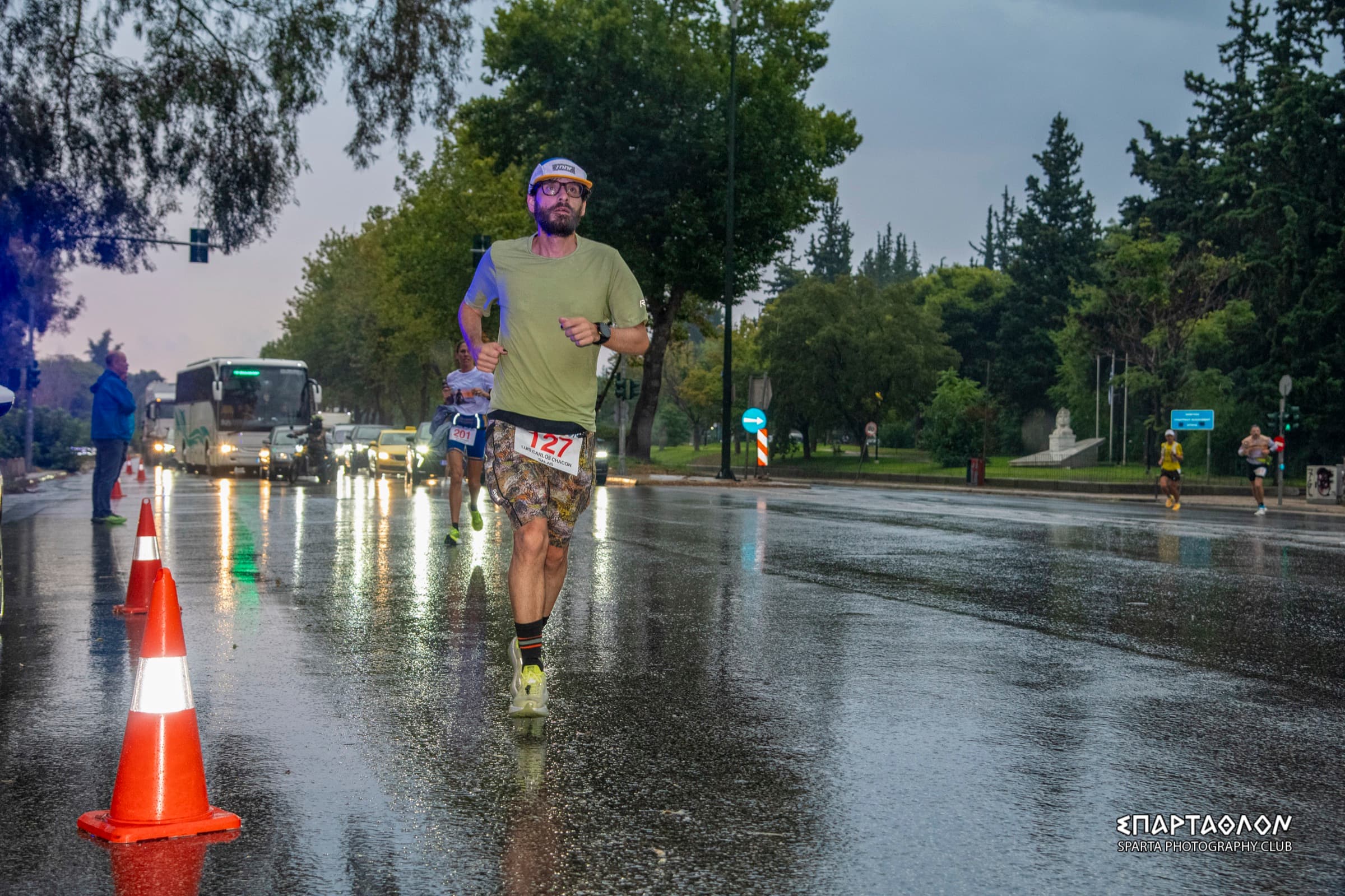
Photo: Sparta Photography Club
km 0 → 43 · Sat 07:00 → Sat 11:05
The rain didn’t let up until a few kilometers before the first aid station where crews are allowed, at kilometer 43. I kept wondering whether to change clothes, but when I got there, my fresh clothes weren’t easy to reach, so I decided to keep going. I wasn’t really that cold or that wet. At that first station I felt good: a bit tired, mostly tired of the route and the rain, but physically fine.
km 43 → 83 · Sat 11:05 → Sat 15:34
The next kilometers had only a few small climbs on a narrow road along the sea, which seemed to never end. Then we ran through towns: ordinary, kind of forgettable, at least judging by the streets we ran by, pretty flat, and still with a lot of rain. My goal of this stretch was to cross the Corinth Canal and get to kilometer 80, not only to see my crew again but also to beat one of the most feared cutoffs in ultrarunning. At Spartathlon you have to cover those first 80 kilometers in under 9 hours and 30 minutes, knowing there are still 166 kilometers to go. If it takes you one second more than that, you are out.
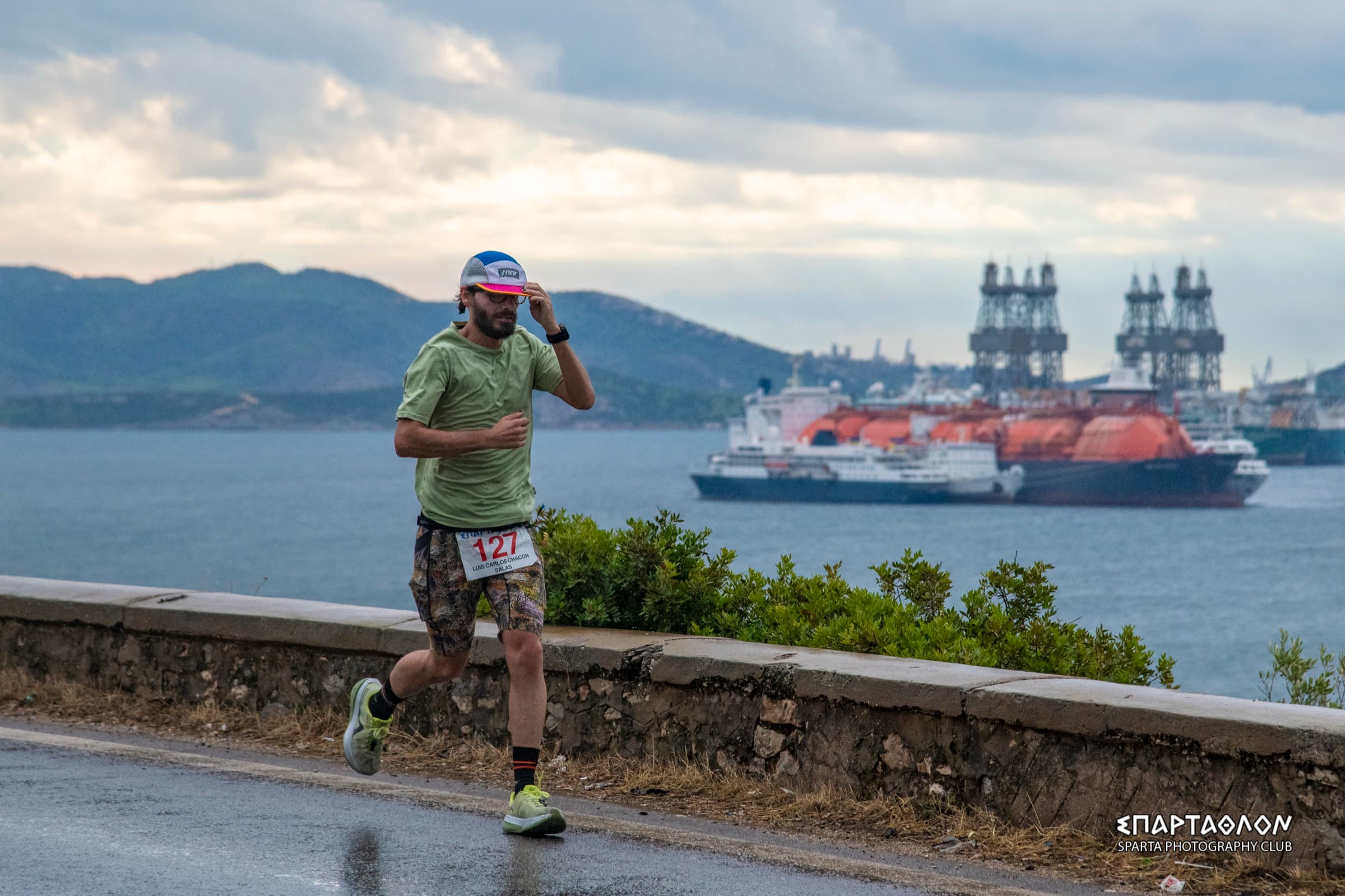
Photo: Sparta Photography Club
km 43 → 83 · Sat 11:05 → Sat 15:34
Somewhere between kilometers 60 and 70 I started to feel some kind of pain. The spot where my right foot meets my leg was hurting. It hurt more when I walked, so at least I could keep jogging. At some point it got so bad that I had to sit down for a while on a pipe next to one of the many refineries we passed by, so I could stretch and check it.
km 43 → 83 · Sat 11:05 → Sat 15:34
The famous Corinth Canal amazed and disappointed me at the same time. I don’t know why, but in all the videos I had watched about Spartathlon it looked bigger, it looked like an epic moment of the race. Crossing the yellow bridge, weaving around tourists and a few runners taking photos, I expected to feel “something,” but I felt nothing different. I was more excited to see my wife and my mom, who were waiting for me at the aid station.
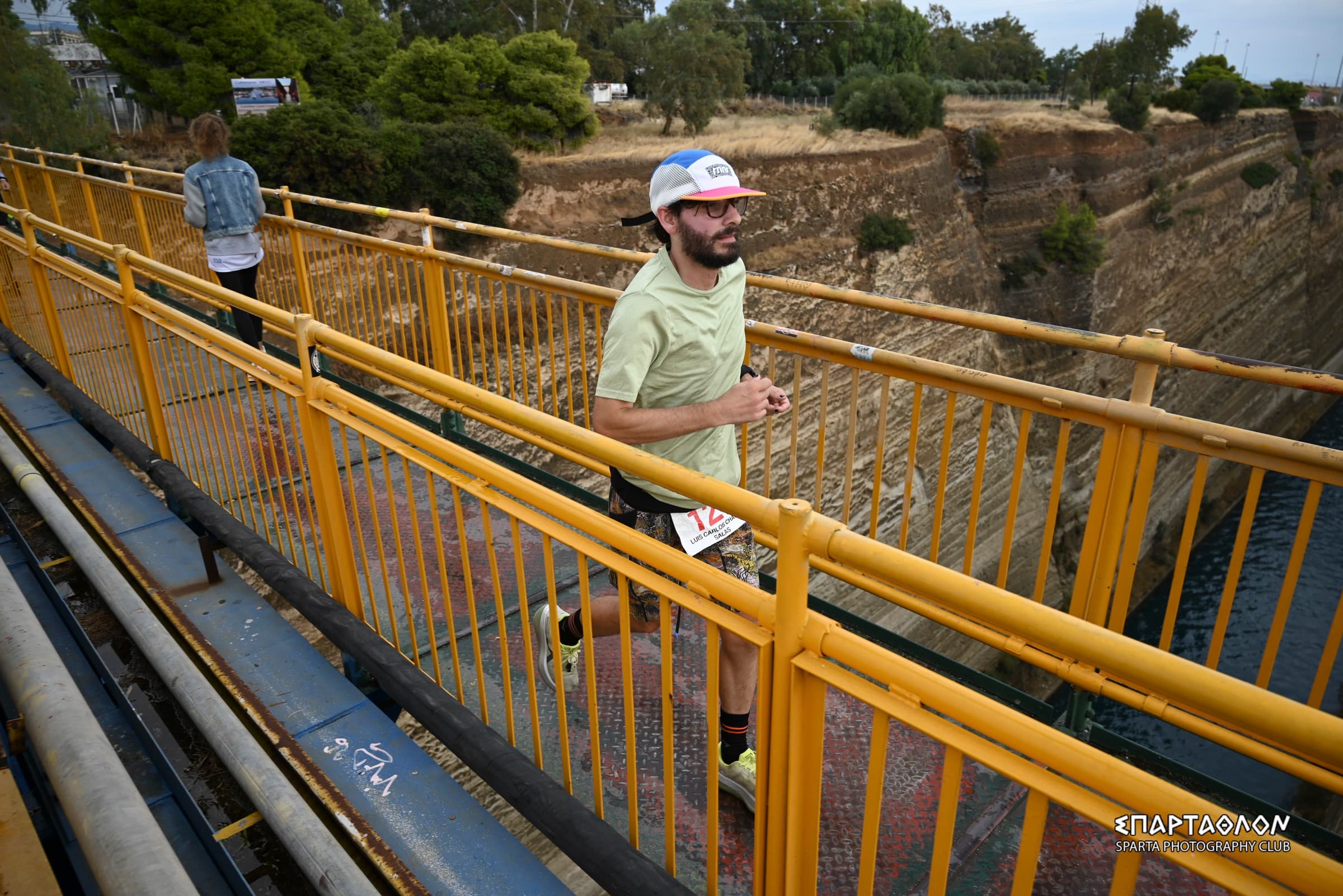
Photo: Sparta Photography Club
km 43 → 83 · Sat 11:05 → Sat 15:34
I walked in, because the station was on a hill. I told them about the pain. They didn’t say much, because I always ask them not to tell me how bad I look, no matter what. I don’t want ideas in my head that could prompt me to give up. That’s something I need to rethink. Later they told me they started thinking it was still way too early for that kind of pain: there were still 166 kilometers and more than 25 hours of racing to go. I had finished the hardest part in terms of speed; the hardest part in terms of climbing was about to begin. I also left the station walking, even though the ground was already flat.
km 83 → 101 · Sat 15:34 → Sat 17:40
The route would stay pretty flat until kilometer 100. Everything hurt a little more with each step. Along the way I met several runners. A guy from Austria told me that the only time he finished, he had to walk the last 20 kilometers; that was his third try. I ran a few minutes with a woman from the United States, and a few more minutes, twice, with the same guy from Argentina; they told me a bit of their story. A guy from Brazil told me that some runners run again the next day in reverse, in order to complete Pheidippides’ original route. None of them had finished on their first try.
km 83 → 101 · Sat 15:34 → Sat 17:40
At kilometer 100 I met my wife and my mom again. The pain kept getting worse, but I could still run. Both feet hurt, especially the right one, and my left groin started to hurt every time I went from walking to running. By pure luck, a friend had given my mom a small jar of a muscular pain ointment. She started rubbing it on me, and it helped me stay warm and handle the pain a little better. I grabbed my headlamp and changed into a long-sleeve shirt. Night was falling.
km 101 → 148.5 · Sat 17:40 → Sun 00:10
In the dark everything looked a bit more monotonous. I kept counting down checkpoints, out of the 75 we had to pass. I saw my crew a few more times; I imagine they were worried. At some point the pain got so bad that I had to start taking paracetamol. Painkillers are common among ultrarunners, but I had never used them. I don’t like to mask pain, and because of my digestive condition, the “strongest” thing I can take is paracetamol. In fact, I only carried a blister pack of paracetamol due to my ulcerative colitis, in case my stomach or colon started hurting. I ended up using it for that strange pain in my foot.
km 148.5 → 159.4 · Sun 00:10 → Sun 02:20
The uphill walking section was coming. Again, in my innocence of trail runner, I thought the elevation changes would let my sore muscles rest and refresh me for the last part of the race. The climb up Mount Parthenion starts in the valley, at Lyrkia, around kilometer 148.5, and goes up to the Sangas pass at kilometer 162. That’s 13.5 kilometers with 950 m of climbing. During that whole climb, on endless asphalt, at night, in the cold, the pain would become unbearable.
km 159.4 · Sun 02:20
“With this man, as Pheidippides himself said and as he made report to the Athenians, Pan chanced to meet by mount Parthenion, which is above Tegea; and calling aloud the name of Pheidippides, Pan bade him report to the Athenians and ask for what reason they had no care of him, though he was well disposed to the Athenians and had been serviceable to them on many occasions before that time, and would be so also yet again. Believing that this tale was true, the Athenians, when their affairs had been now prosperously settled, established under the Acropolis a temple of Pan; and in consequence of this message they propitiate him with sacrifice offered every year and with a torch-race.”
km 159.4 · Sun 02:20
Somehow I made it to the mountain base. My wife told me I had already finished the climb. I knew I hadn’t. I pointed at the lights slowly moving up into the sky: I still had to climb the 2 kilometers of trail, the 2 steepest kilometers of the race. She asked me how bad it hurt, from one to ten. I told her: “I don’t know, ten? It hurts way too much, I can barely walk, I don’t know how I’m going to keep going.”
km 159.4 · Sun 02:20
Part of my mind had decided to stop right there. The other part was thinking that we didn’t have a hotel booked for that night (where were we going to sleep?), that I had already suffered so much, and that if I ever wanted to finish this race in my life, it had to be now, because I really didn’t want to go through those first 160 kilometers again. I don’t understand why some people come back to this race again and again. The two of them looked at me, worried. My wife said we should go to the checkpoint and see what we could do.
km 159.4 · Sun 02:20
At Spartathlon, several checkpoints have volunteer physical therapists who give massages. That’s another thing I had never done in the middle of a race, but I had to try anything. There were still more than 80 kilometers to go. I took off my shoes and lay down on the table. They asked me where it hurt the most; I said my right foot, where the foot meets the leg. The young woman started massaging the area. She asked if it was my first Spartathlon. I said yes. She said she felt bad this was happening to me, half laughing and half worried. The massage hurt a lot, but my eyes were also starting to close from sleepiness.
km 159.4 · Sun 02:20
After a few minutes she said it was better to stop the massage, because if I stayed lying down I wouldn’t be able to warm up again. Sure enough, I put my shoes back on, walked out of the tent, and I was shivering. I put on both jackets I had, my wife brought me a hot tea, and I started walking toward the top of the mountain. Everything still hurt, but at least I could move a little better. I told myself: “If I can’t run again by the next time I see them, I’ll have to drop out of this race.”
km 159.4 → 163.5 · Sun 02:20 → Sun 03:29
I climbed the mountain at what felt like a good pace, but then, what goes up must come down. First about 2.3 kilometers with around 350 m of descent, on dirt and loose rock. On those kilometers I tried to jog. My left groin hurt too much, and I could barely move my legs in a way that resembled running. Another runner was walking down faster than I could “run.” Little by little I warmed up, until I could jog again on the flatter parts, with a lot of pain, but it was running. I wasn’t out yet. I set myself a new goal: “If I can run at least 6 kilometers every hour, I can finish this race.”
km 159.4 → 163.5 · Sun 02:20 → Sun 03:29
The big challenge of Spartathlon is finishing the 246 kilometers in under 36 hours, passing each of the 75 cutoffs along the way on time. With my new goal, I jogged what I could and walked the rest of each hour. Walking gave me some rest, but my right foot hurt more. When I started running again, the pain in my left groin was unbearable until it warmed up a little. Even so, every hour I could still cover between 5 and 7 kilometers, though a little less each hour.
km 159.4 → 163.5 · Sun 02:20 → Sun 03:29
“However at that time, the time namely when he said that Pan appeared to him, this Pheidippides having been sent by the generals was in Sparta on the next day after that on which he left the city of the Athenians; and when he had come to the magistrates he said…”
km 163.5 → 221 · Sun 03:29 → Sun 12:45
I kept seeing my mom and my wife at the aid stations. I imagine I looked worse every time, but I think they were also surprised that I was still running. Seeing them gave me a boost, but every time I saw them I had to leave again as fast as possible, to keep moving. That’s how these races are: every time you see the people you love, who support you, it’s a new goal, and when you reach it, the relief lasts very little and everything starts over again. In my mind, I tried to reassure them by telling them that my runner math said I could walk almost everything and still make it on time.
km 163.5 → 221 · Sun 03:29 → Sun 12:45
After climbing the mountain at Spartathlon, you think there can’t be more climbing; you’ve already reached the highest point. Wrong. Around kilometer 200, already in the morning, you leave a road and turn left to start a 30-kilometer stretch on the Tripoli-Sparta highway. This stretch has about three endless climbs with nothing to see and nothing to do but to keep walking. Cars on the highway pass by the runners really fast.
km 163.5 → 221 · Sun 03:29 → Sun 12:45
After more than 24 hours on the move, even though I had drunk liters of Coke and two caffeine gels, my eyes kept closing from sleepiness. At one point I felt like I fell asleep while walking, and a car that passed right next to me, going at who knows what speed, woke me up. It scared me a lot. Not enough, though, because I kept falling asleep. At the next checkpoint, a kiosk next to the highway, I sat down, had a coffee and a Coke, and started walking again. The climbs never ended, and starting to run on the downhills was unbearable. I pushed myself to do it, because I had to make the most of them and keep doing my best to reach 6 kilometers per hour.
km 221 → 234 · Sun 12:45 → Sun 15:05
The caffeine took me almost to kilometer 221. That’s where the aid station before what would really be the last climb was, still on the highway. I could barely handle the pain or the sleepiness. I had another coffee and another Coke, and my mom rubbed on the last bit of ointment left in the little jar. Now I could walk all the way to Sparta and still make it on time.
km 221 → 234 · Sun 12:45 → Sun 15:05
I climbed the final hill; the wind was extremely strong. Only 20 kilometers left, all downhill. Walking hurt my feet way too much. I tried to start jogging, but my groin wouldn’t let me; the pain was truly unbearable. I tried a few more times. I really couldn’t. All I could do was walk and endure the pain in each foot with every step. I had plenty of time to finish under 36 hours.
km 221 → 234 · Sun 12:45 → Sun 15:05
It took me two and a half hours like that to see my mom and my wife again, at kilometer 234. I changed my shirt, partly because on Sunday afternoon you could already feel the heat you’d expect at Spartathlon, but mostly because in the days before, I had visualized myself arriving at the feet of the statue of Leonidas in that outfit. I thought that in order to improve my chances of making it, I had to make my visualization more and more real.
km 234 → 241 · Sun 15:05 → Sun 16:22
I kept walking, downhill, 10 more kilometers, two more hours. Nothing else mattered; I just wanted to get there. In those four hours I must have been thinking a lot, but I don’t remember what about. Maybe I thought about nothing. The pain kept me in the present place and moment: an unorthodox, and not very recommended, form of mindfulness.
km 241 → 246.6 · Sun 16:22 → Sun 17:20
“Lacedemonians, the Athenians make request of you to come to their help and not to allow a city most anciently established among the Hellenes to fall into slavery by the means of Barbarians; for even now Eretria has been enslaved, and Hellas has become the weaker by a city of renown.” He, as I say, reported to them that with which he had been charged, and it pleased them well to come to help the Athenians; but it was impossible for them to do so at once, since they did not desire to break their law; for it was the ninth day of the month, and on the ninth day they said they would not go forth, nor until the circle of the moon should be full. These men were waiting for the full moon: and meanwhile Hippias the son of Peisistratos was guiding the Barbarians in to Marathon…
km 241 → 246.6 · Sun 16:22 → Sun 17:20
The last 3 kilometers are already in the town of Sparta. The woman from the United States passed me again, still jogging. I was happy for her and congratulated her. The closer I got to the finish, the more the adrenaline, or whatever was numbing my pain a little, faded away. I thought it would be the other way around and that I would finish running; that happens a lot. Maybe my body, knowing this was almost over, was screaming at me to rest, to stop.
km 241 → 246.6 · Sun 16:22 → Sun 17:20
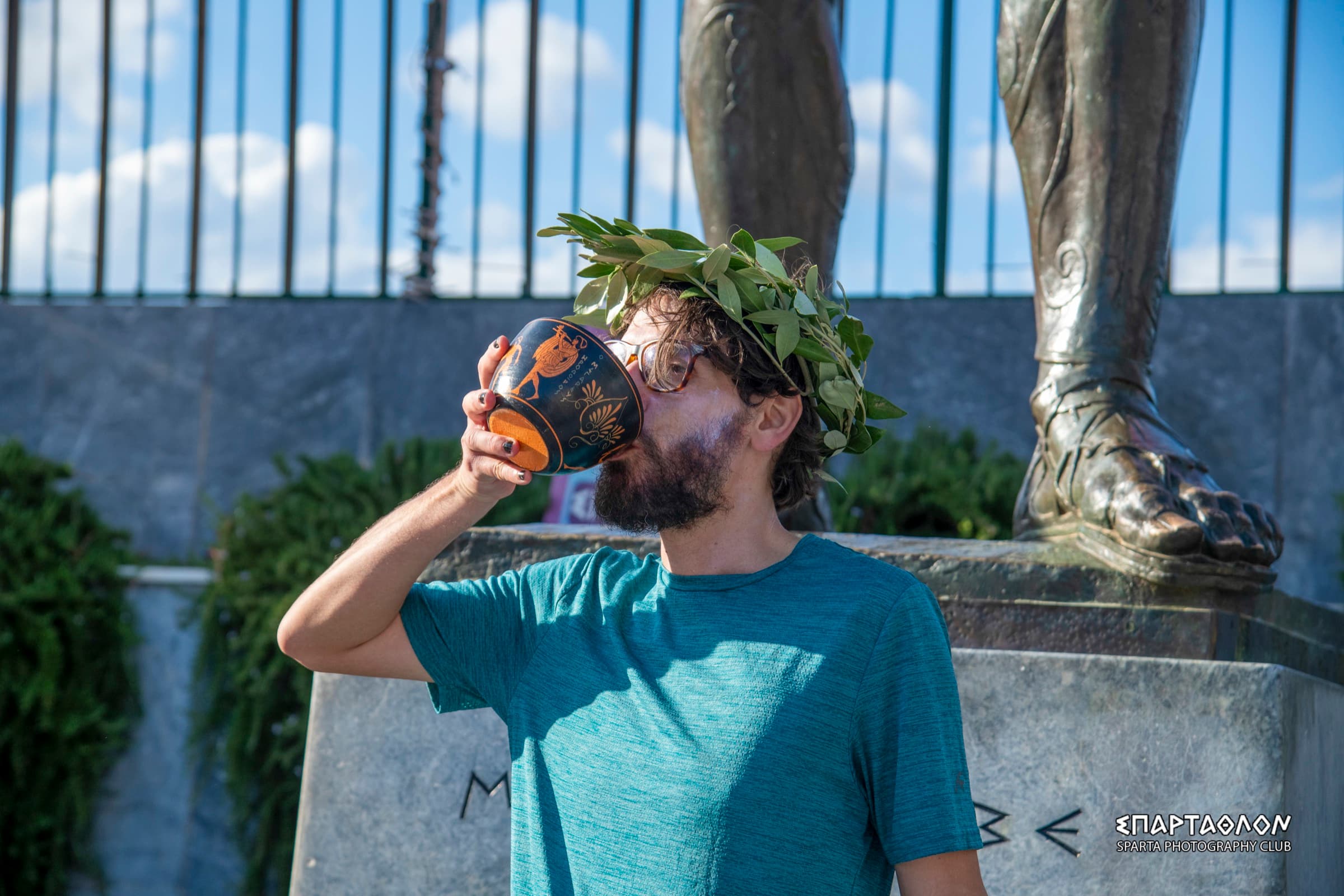
When I made the last right turn, onto the avenue that ends at the feet of Leonidas, the tears started to come. Or not, because I was dehydrated, but I wanted to cry. It felt like the whole town was congratulating me from the balconies and the cafés. All the kids wanted a high five. The flags of every country represented by the runners were waving. I saw my mom and my wife cheering for me and taking photos and videos. I touched Leonidas’ foot and, without a second thought, gave it the kiss that seals the end of the race where I have suffered the most. All of Sparta kept clapping, and there I was at the finish, with a laurel wreath and the finisher’s plaque. After 246 kilometers and 34 hours and 22 minutes from Athens to Sparta, I had beaten the venomous snake made out of asphalt, and for a few minutes I was truly happy.
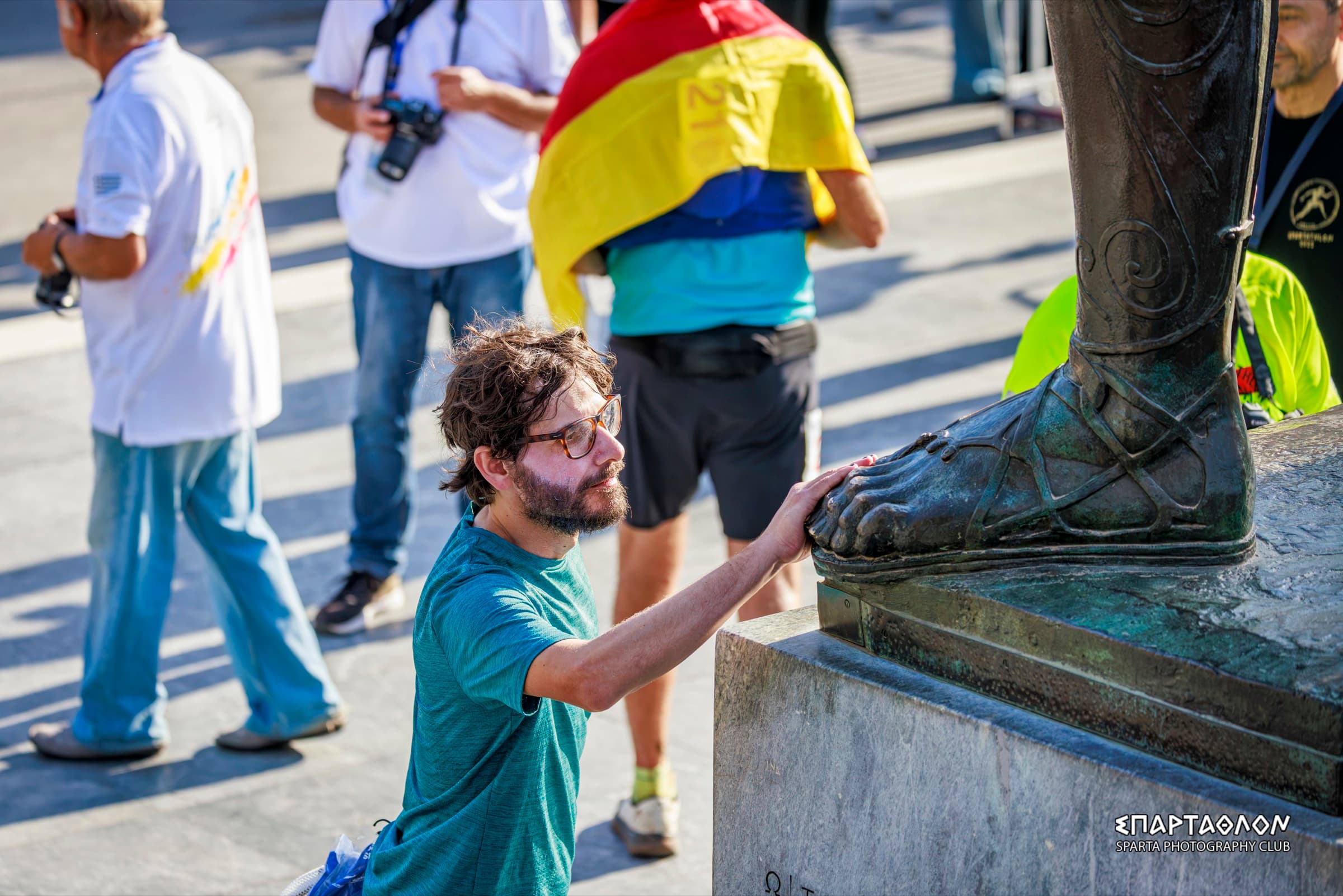
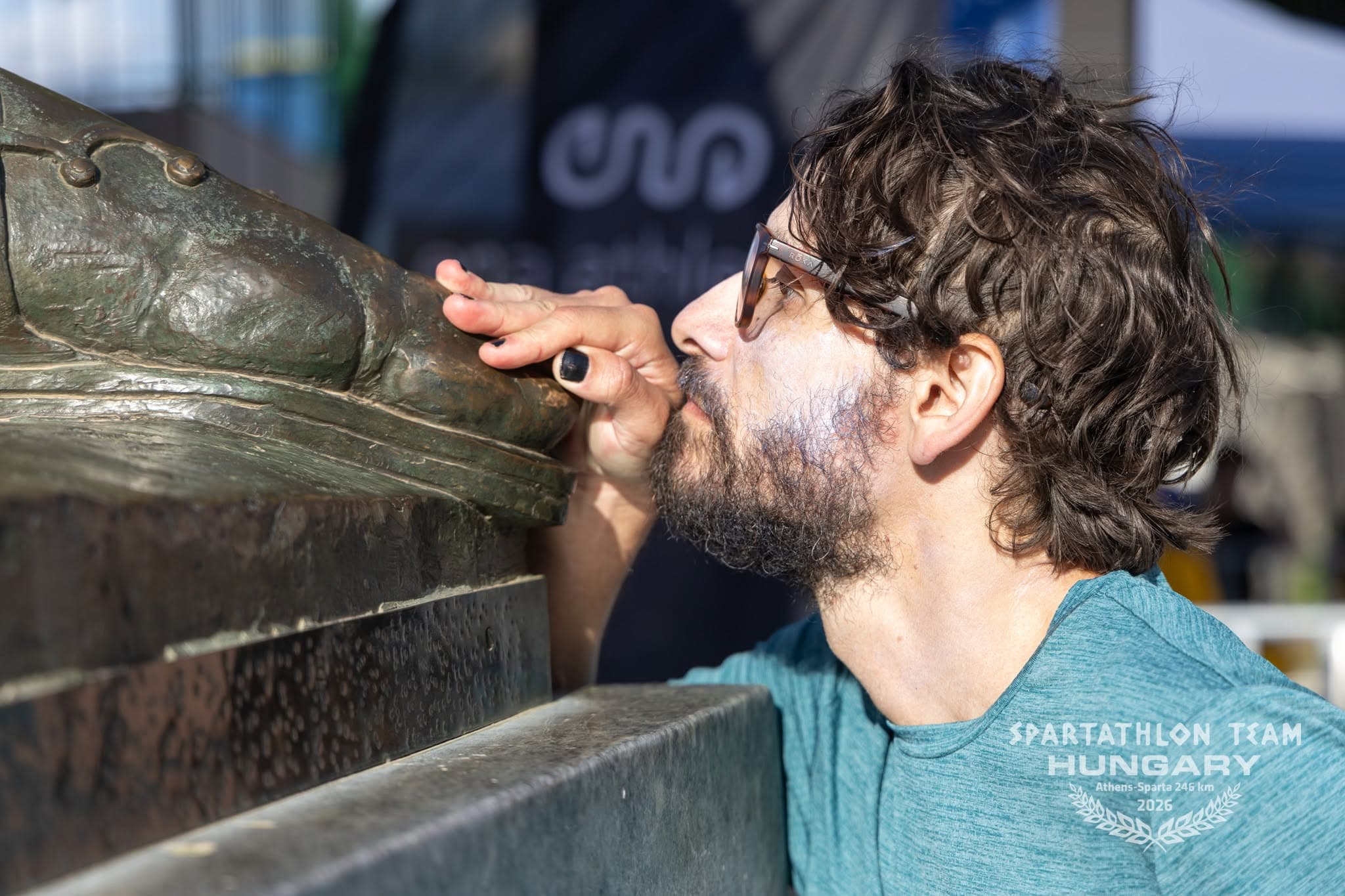
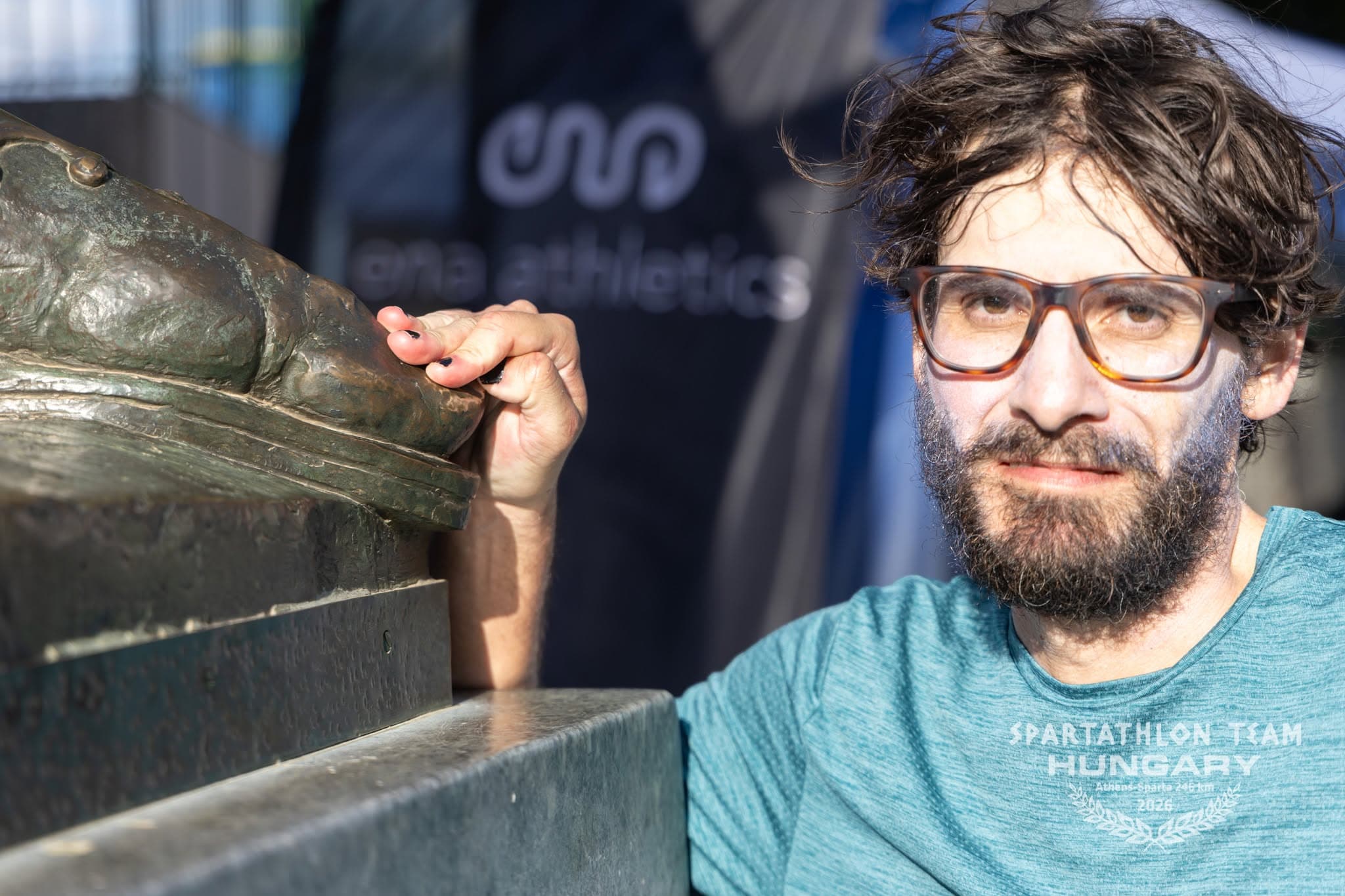
Photo: Sparta Photography Club
Kilometres in each hour
Each bar is one hour of the race. The line marks 6 km per hour, the goal I set myself after the mountain. The red line is the elevation in those same hours.
| Hour | km |
|---|---|
| Sat 07:00 | 11 |
| Sat 08:00 | 10.5 |
| Sat 09:00 | 10.3 |
| Sat 10:00 | 10.3 |
| Sat 11:00 | 8.9 |
| Sat 12:00 | 9.6 |
| Sat 13:00 | 9.3 |
| Sat 14:00 | 8.9 |
| Sat 15:00 | 8.2 |
| Sat 16:00 | 8.3 |
| Sat 17:00 | 7.7 |
| Sat 18:00 | 8.4 |
| Sat 19:00 | 7 |
| Sat 20:00 | 7.2 |
| Sat 21:00 | 7.2 |
| Sat 22:00 | 7.4 |
| Sat 23:00 | 7.7 |
| Sun 00:00 | 5.9 |
| Sun 01:00 | 4.7 |
| Sun 02:00 | 3.1 |
| Sun 03:00 | 5.6 |
| Sun 04:00 | 5.6 |
| Sun 05:00 | 6.5 |
| Sun 06:00 | 6.6 |
| Sun 07:00 | 5.7 |
| Sun 08:00 | 6.4 |
| Sun 09:00 | 5.1 |
| Sun 10:00 | 6.8 |
| Sun 11:00 | 6.2 |
| Sun 12:00 | 6.9 |
| Sun 13:00 | 5.1 |
| Sun 14:00 | 5.8 |
| Sun 15:00 | 5.4 |
| Sun 16:00 | 5.6 |
| Sun 17:00 | 2.1 |
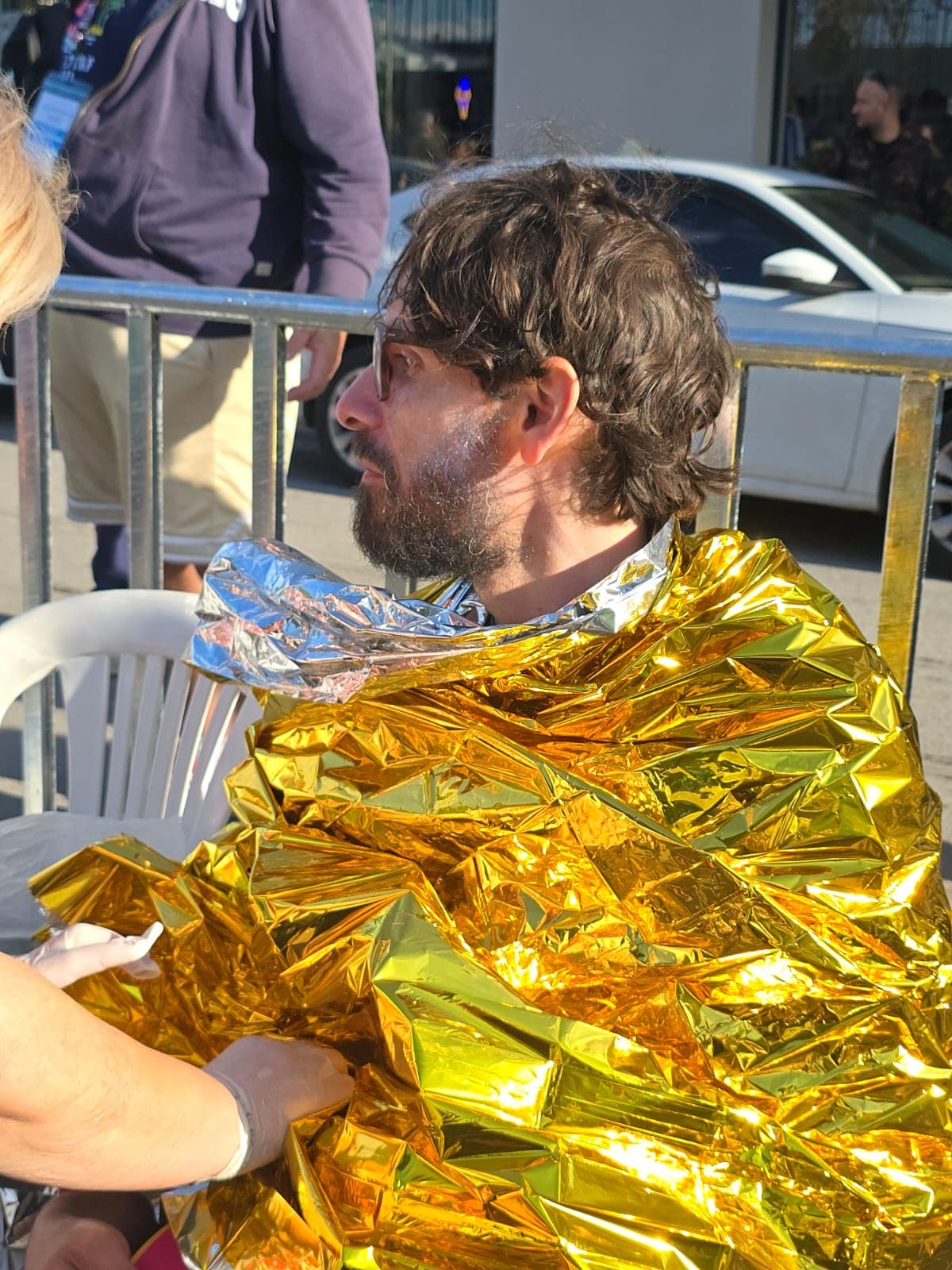
When you leave the finish area, volunteers give each finisher a quick check. A lady sat me down on a chair, took off my shoes and put on slippers, and that’s when I saw for the first time what had happened to me. On each foot, right where the tongue of the shoe sits, I had a big red patch of swelling, the one on the right foot bigger and redder. After a few minutes I stood up to go to the Airbnb, and I could barely walk. The swelling in my right foot was spreading down into the foot, making it bigger and bigger. The pain in my groin, probably from compensating, wouldn’t let me lift my left leg. I couldn’t make it to our car, parked about two blocks from the finish. My wife had to go get it and come back for me.
Fighting a venomous snake, even if it’s partly imaginary and partly just asphalt under your feet, doesn’t leave you unharmed. The following weeks were kind of a disaster for my body. In the first days my right foot swelled so much that it only fit in some big socks my mom had brought us as a gift, and in some Super Mario Crocs she had also given me for Christmas. Again, thanks to “luck,” or to her, I had something to put on my foot. My stomach and colon also got out of balance. So I spent the days lying down or limping around, and going to the bathroom pretty often. Two weeks later, little by little, I’m finally getting back to normal, although I still feel quite tired and out of my homeostasis.
Actions aren’t always decisions, even if they look like it. During the race, even though I kept thinking “what if this or that,” “I have to do this or that,” the only thing I really kept doing nonstop was putting one foot in front of the other. Even though that led to what looks like a decision to fight against everything and reach Sparta, it was just one small action after another. You can call it stubbornness or recklessness, but I feel it’s just a mode you enter at the start line, and I haven’t figured out how to turn it off. This probably should have been my first DNF (did not finish), and I don’t know if I want to suffer like that again. Clearly, I need to learn to take better care of myself somehow. I need to work on making my physical strength match what seems to be my “mental strength,” my “race mode.” On the other hand, I’m also proud of what I achieved. I feel that the physical and mental strength I do have comes from effort, work, training and discipline. I’m happy to be part of this story that started with Pheidippides’ steps in 490 BC and continues today with ours.
In a video Fran Bowtie’s girlfriend made for him, she tells him she wishes he could see himself through the eyes of everyone who supported him from near and far. I wish we could do that. During the race I’m in every kilometer, in the pain, in the now; there’s only asphalt and my feet, not much else. Now, writing this, I remember the videos where my mom describes what she feels watching me race, the messages my wife showed me from friends who were following the stories she posted about my race, the messages from my family, my wife’s words, the support of the people watching me walk through Sparta, the Greek kids asking my name and where I was from, and I get a lump in my chest and in my throat. I feel happy again, like when I reached the feet of Leonidas, and now that’s a memory I can summon whenever I need it. That’s what I keep with me after following Pheidippides’ road from Athens to Sparta.
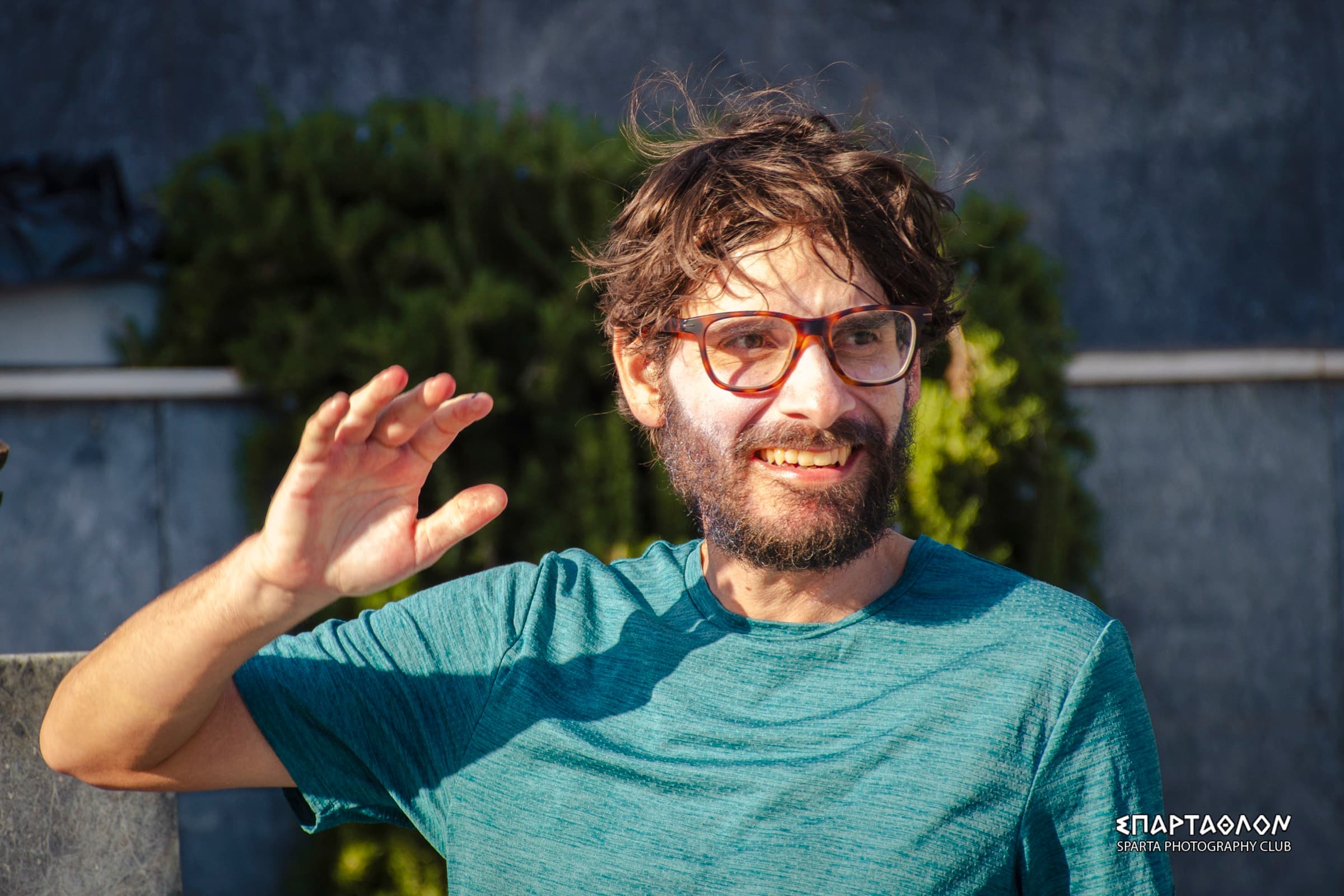
Photo: Sparta Photography Club